Regulations stall growth of South Korea’s tech startups
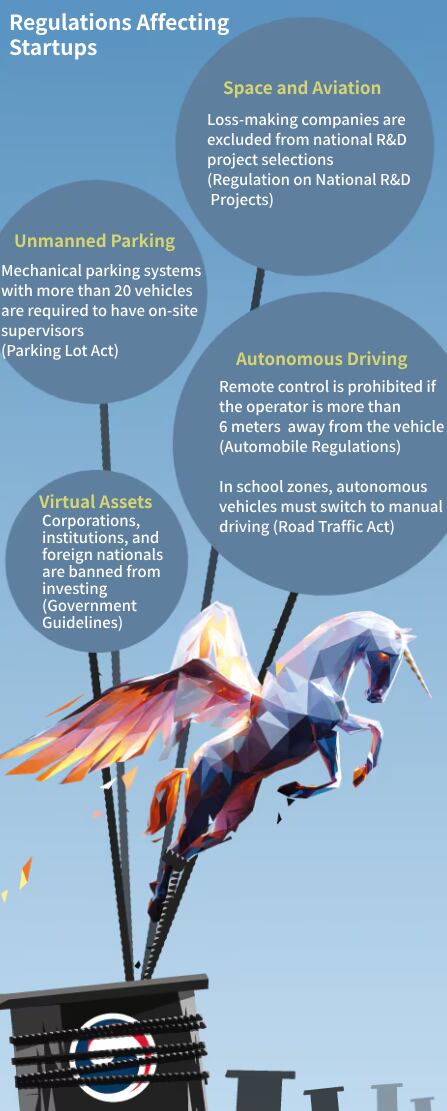
Jung Yoo-sang, 35, CEO of Gorae Universe, launched his startup last year with the goal of building a fully automated, unmanned parking tower using mobile apps, robotics, and autonomous driving technology. Previously an engineer at a company that developed Light Detection and Ranging (LiDAR) sensors—a core component of self-driving systems—Jung quickly ran into regulatory hurdles. Under the current Parking Lot Act, mechanical parking systems designed for more than 20 vehicles are required to have on-site human supervisors at all times. “If we have to rely on people, it defeats the purpose of the technology,” Jung said. “We plan to apply for regulatory sandbox approval first,” he added, referring to a government system that grants temporary exemptions from existing regulations.
A startup founded in 2018 that developed facial recognition technology for pets faced a similar roadblock. The current Animal Protection Act only recognizes implantable or external microchips as valid means of registering animals in the national database. It wasn’t until 2021 that the company was able to launch its business after securing temporary approval under the regulatory sandbox framework. However, the exemption must be renewed every two years, and the underlying regulation remains in place, constraining the company’s growth. “The extension expires at the end of this year,” said a company official. “If the law doesn’t change by then, we may have to abandon the government project entirely.”
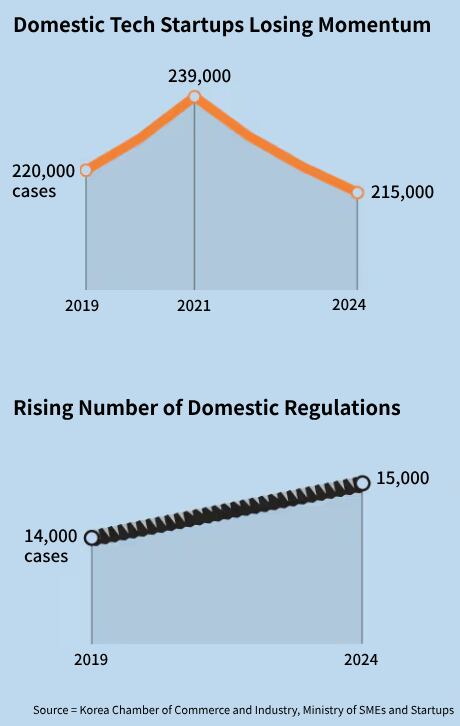
As South Korea grapples with a year of negative growth and a prolonged economic slowdown, innovation and startup activity are more critical than ever to fuel the next phase of growth. Yet many domestic tech startups are finding themselves stalled by entrenched regulations that serve as invisible barriers to advancement. According to the Ministry of SMEs and Startups, the number of technology startups fell by more than 10 percent, from 239,620 in 2021 to 214,917 last year. Meanwhile, the number of registered domestic regulations increased from 13,922 in 2019 to 14,961 in 2022, based on data from the Korea Chamber of Commerce and Industry. “Every new administration talks about deregulation, but the end result is always more red tape,” said Jeon Sung-min, a professor at Gachon University and former president of the Korean Society of Business Venturing and Entrepreneurship. “When startups that are pioneering new markets are blocked by regulation, it puts the future of entire industries at risk.”
Regulatory hurdles continue to stifle progress in several high-tech sectors. For instance, the Ministry of Trade, Industry and Energy’s “Operation Guidelines for Projects for Innovation for Industrial Technology” bars so-called “marginal firms”—those with three consecutive years of operating losses—from participating in government-funded research and development programs.
The issue, startup founders say, is that most companies developing emerging technologies are still in the early stages and have yet to reach commercial viability, making losses inevitable.
“While exceptions are made for companies with a Technology Credit Bureau (TCB) rating of BBB or higher, the TCB system puts heavy emphasis on financial indicators such as revenue,” said the head of a startup developing satellite components. “So even if a company has strong technology, it’s nearly impossible to secure that rating. Government R&D programs are essentially out of reach for us.”
While the United States and China have already commercialized autonomous robotaxis, South Korea’s self-driving sector remains stuck in the pilot stage due to regulatory constraints.
Currently, 471 autonomous vehicles operate in designated pilot zones across the country, but only one—developed by startup RideFlux—has been approved to run without a safety driver behind the wheel.
“Even within pilot zones, if the vehicle enters a school zone, it must be switched to manual mode, which makes proper testing impossible,” said a mobility industry insider.
To commercialize fully driverless vehicles, remote human operation is essential for addressing unexpected issues. However, current regulations limit remote control to within 6 meters of the vehicle for safety reasons.
“Without lifting the ban on remote driving, the commercialization of autonomous vehicles is simply not feasible,” said Yoo Sang-min, chief strategy officer at Autonomous A2Z, which operates the largest fleet of autonomous vehicles in South Korea with 55 units.

Posting Komentar untuk "Regulations stall growth of South Korea’s tech startups"
Posting Komentar