How the Iran-Israel conflict could destabilize Pakistan
The Israel-Iran conflict could trigger new security and economic challenges for Pakistan, which is already grappling with militancy, separatism and economic instability.
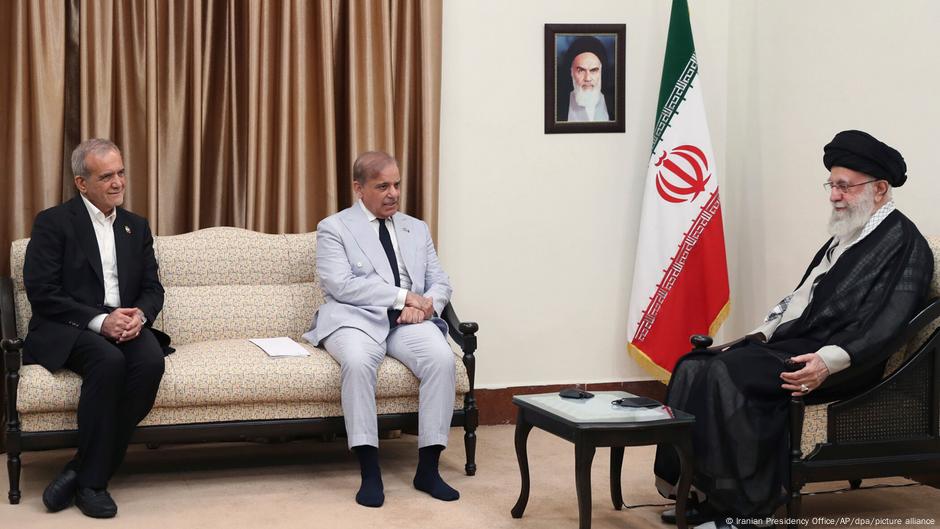
The escalating Israel-Iran conflict has far-reaching security, geopolitical and economic implications for Iran's southeastern neighbor, Pakistan.
Iran shares a 909-kilometer (560-mile) border with Pakistan's restive Balochistan province, where officials announced on Monday that all formal border crossings with Iran had closed for an indefinite period amid intensifying strikes between Israel and Iran.
The crossings at Taftan and Gabd-Rimdan in southwest Balochistan remain open for nationals seeking to return home. Hundreds of Pakistanis living in Iran arrived at the Taftan border crossing on Wednesday as they make their way back home to Pakistan.
Pakistan's army chief, Field Marshal Asim Munir, is expected to meet US President Donald Trump later on Wednesday during his official visit to Washington. The meeting is deemed siginficant in the light of the ongoing Iran-Israel conflict.
Pakistan's relationship with Iran
The relationship between predominantly Sunni Pakistan and Shiite-majority Iran has been complex, with the cross-border region affected by attacks from Baloch separatists who are fighting a war of independence against the Pakistani state.
The Balochistan Liberation Army (BLA) says Pakistan's central government is unfairly exploiting the region's natural resources.
The BLA has for decades launched attacks against the government, armed forces and Chinese interests in the region .
The Israel-Iran war marks a dangerous turning point not only for Middle East geopolitics, but for Pakistan, according to US-based Pakistan analyst Raza Rumi, who told that "the implications are [anything but] distant."
"As a country with close ties to key Gulf allies and a complex relationship with Iran, Pakistan will be under pressure to maintain neutrality while safeguarding its strategic interests," Rumi added.
As fighting between Israel and Iran entered its sixth day on Wednesday, the Israel Defense Forces (IDF) announced that they were attacking Tehran, Iran's capital, fueling fears of an all-out war in the region.
Increasing conflict and a potential collapse of Tehran could have serious security implications for Pakistan. Separatist attacks in Balochistan could impact Pakistan's border security and internal stability — challenging its already strained security apparatus.
"There is the thorny issue of the Baloch region [in Iran] and a collapse in Tehran could trigger autonomy claims which will embolden the Baloch in Pakistan. Iran and Pakistan have been at loggerheads over this issue in the past," Ghaffar Hussain, a London-based security, expert told .
For analyst Rumi, "Islamabad would have to bolster border surveillance and work carefully in balancing law enforcement with diplomatic sensitivity toward Tehran."
"A war on the western border [with Iran] is problematic for Pakistan, especially its restive Balochistan province," said Muhammad Shoaib, an assistant professor at Quaid-i-Azam University.
Shoaib added that any change to the status quo will be troublesome and a weakened regime would also "present a security challenge."
Economic impacts
The escalating conflict between Israel and Iran has renewed focus on security in the Strait of Hormuz — a strategic waterway between Oman and Iran that connects the Persian Gulf with the Gulf of Oman and the Arabian Sea.
A wider conflict in the Middle East, especially around the Strait of Hormuz, could disrupt global oil supplies and drive prices higher, said Rumi.
"Like the rest of the world, Pakistan would be severely impacted, and the war could risk major disruption of oil flows through the Strait of Hormuz, which could lead to soaring global energy prices," said Rumi, who noted that Pakistan is already grappling with inflation, currency depreciation and energy shortages.
As a result of the war, rising fuel costs could disrupt markets and key sectors, such as electricity generation, transportation and agriculture, deepening the fiscal crisis and putting further strain on vulnerable households.
"Whether or not Iran has the ability to block the strait of Hormuz remains to be seen … but this would embroil the entire region including GCC nations," asserted Hussain.
Shoaib, however, feels that the "Iranian conflict, in particular, will impact Balochistan province where a significant chunk of population is [engaged in] informal trade of oil and other commodities."
Sectarian tensions
According to Rumi, Pakistan — a predominantly Sunni Muslim country where Shiite Muslims make up about 15% of the population — could face a potential spillover of sectarian tensions and the country may see renewed propaganda, targeted violence, and proxy activities.
"If the war narrative is infused with religious symbolism and sectarian rhetoric, it could be dangerous," Rumi said.
Edited by: Keith Walker
Author: Haroon Janjua (in Islamabad)

Posting Komentar untuk "How the Iran-Israel conflict could destabilize Pakistan"
Posting Komentar